
Psychedelics Education
DMT Drug Checking in the United States: What Test Kits Can—and Cannot—Tell You
Nov
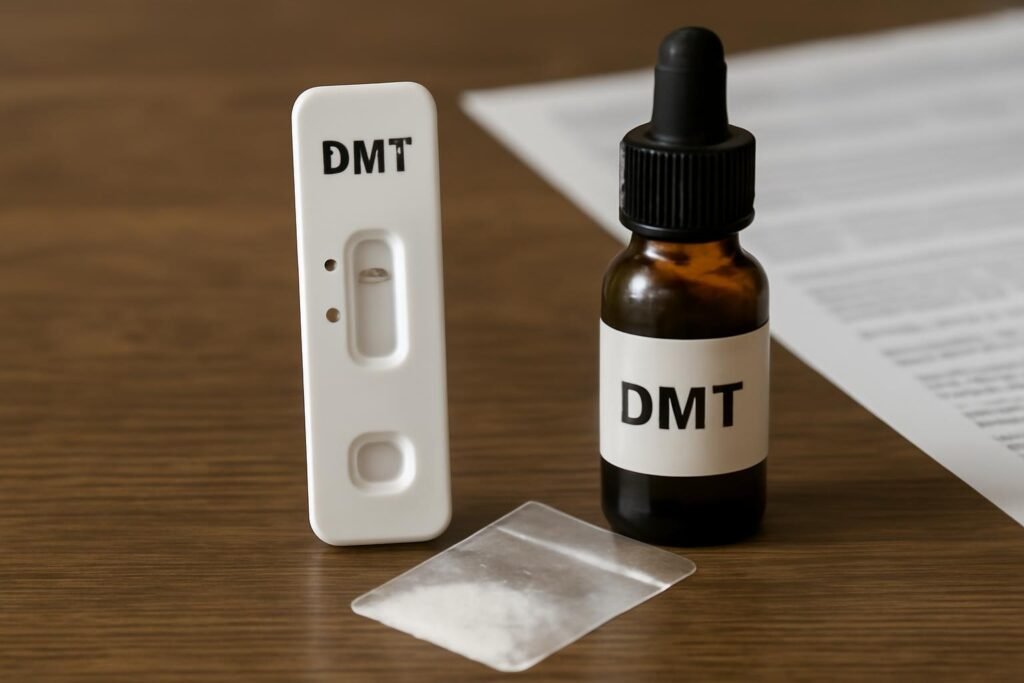
DMT drug checking is often discussed as though a small reagent bottle or test strip can answer one simple question: “Is this really DMT?” In practice, the answer is more complicated. Consumer kits may provide limited information about the presence of certain chemical groups, but they generally cannot confirm exact identity, concentration, contamination, or whether a product is safe to use.
That distinction matters because products marketed as NN-DMT, 5-MeO-DMT, changa, cartridges, disposable pens, or other psychedelic preparations can differ substantially in chemistry and risk. Mislabeling, uneven mixing, degradation, accidental substitution, and contamination are all possible in unregulated markets. A test result should therefore be treated as one small piece of risk information—not as a safety certificate.
This guide explains what DMT drug testing kits can reveal, where they fall short, how laboratory analysis differs, and what United States consumers should understand before trusting an online claim or product label.
Why DMT drug checking is difficult
DMT is not one single retail format. The term may refer to N,N-dimethyltryptamine, commonly called NN-DMT, or to 5-MeO-DMT, a different compound with a different pharmacological profile. Other products may contain plant material, infused leaf blends, solvents, flavorings, carrier liquids, or additional psychoactive substances.
Appearance is not a reliable identification method. White, yellow, orange, or brown crystals can reflect differences in processing, oxidation, plant impurities, or contamination. A vape cartridge may look professionally packaged while containing an inaccurate concentration or a substance that was never disclosed. Branding and product names are not substitutes for independent analytical testing.
There is also a legal issue. In the United States, DMT and 5-MeO-DMT are generally controlled substances under federal law, subject to important exceptions and evolving state policies. Possession, distribution, importation, and shipping may carry serious legal consequences. A test kit does not make an illegal substance legal, and a “lab-tested” claim does not establish that a seller is authorized to distribute it.
What a consumer DMT test kit may detect
Most consumer reagent kits are designed to produce a color reaction when exposed to certain chemical structures. Depending on the reagent, the reaction may be consistent with a broad class of compounds. Some kits are marketed for tryptamines, while others are intended to screen for a wider range of substances.
A reagent result may help raise a warning when:
- There is no expected color change at all.
- The color appears inconsistent with the manufacturer’s comparison chart.
- The reaction is unusually weak, delayed, or contains unexpected colors.
- Different portions of a product produce visibly different reactions.
- A liquid or powder reacts in a way that suggests an unexpected chemical category.
Even in these situations, a result is presumptive rather than definitive. Similar compounds can produce similar colors, and mixtures can create confusing or overlapping reactions. A positive color response does not prove that the sample contains only DMT, nor does it establish the amount present.
Reagent kits are not potency tests
One of the most important limitations is that a reagent kit cannot tell you how much active compound is present. Two samples can produce similar color reactions while containing very different concentrations. A cartridge can also have uneven distribution, meaning one small sample may not represent the contents of the entire device.
Potency is especially difficult to estimate in vape liquids, plant blends, and products that contain multiple ingredients. A label stating a specific number of milligrams should be treated as an unverified claim unless supported by a credible, batch-specific laboratory report.
What DMT drug testing kits cannot confirm
Consumers frequently overestimate what a test kit proves. A typical reagent test cannot reliably establish all of the following:
- Exact chemical identity.
- Purity or percentage concentration.
- Whether a sample contains multiple active compounds.
- Presence or absence of bacteria, mold, heavy metals, or pesticides.
- Residual solvents or manufacturing chemicals.
- Uniformity throughout a powder, liquid, cartridge, or plant mixture.
- Whether a product is correctly labeled.
- Whether a product is safe for a particular person or medical history.
Fentanyl test strips are also frequently misunderstood. They are designed to detect fentanyl-related compounds in certain solutions, not to identify DMT or certify a sample as safe. A negative result does not exclude other contaminants, unexpected psychoactive drugs, dose errors, or non-fentanyl opioids.
Laboratory testing is more informative—but not perfect
Laboratory analysis can provide substantially more information than a home reagent kit. Depending on the laboratory and method, analytical testing may identify compounds using techniques such as chromatography and mass spectrometry. Testing may also estimate concentration and detect some contaminants.
However, the quality of a laboratory report depends on several factors:
- Sample authenticity: The report must relate to the exact batch or sample being offered, not merely to a similar product.
- Chain of custody: A seller should be able to explain how the sample reached the laboratory and whether substitution was possible.
- Testing method: Different methods have different detection limits and capabilities.
- Panel scope: A report that tests only for one compound may not assess heavy metals, solvents, microbes, or other drugs.
- Report date: Old results may not represent a new batch or a reformulated cartridge.
- Independent verification: A logo or downloadable PDF can be copied, altered, or presented out of context.
A credible report should identify the laboratory, sample or batch identifier, date, analytical method, detected compounds, and limitations. Claims such as “99% pure” without verifiable documentation should not be treated as evidence.
How to evaluate a product-testing claim
Whether you are reviewing a website, retreat provider, social media listing, or informal marketplace advertisement, look beyond phrases such as “lab tested,” “pharmaceutical grade,” or “natural.” Those phrases can sound authoritative while providing no meaningful quality information.
Ask these questions:
- Is the report tied to the exact product and current batch?
- Does it identify both the target compound and unexpected compounds?
- Does it include concentration data rather than only a pass/fail statement?
- Are the laboratory and method clearly identified?
- Does the report disclose what was not tested?
- Can the information be independently verified?
- Does the seller make unusually strong claims about safety, legality, or therapeutic benefits?
Pressure to pay quickly, requests for cryptocurrency or gift cards, anonymous messaging accounts, and promises of “discreet guaranteed delivery” are not signs of quality control. They are warning signs associated with scams and legal exposure. For general educational context, readers can review the site’s DMT information hub, while remembering that product listings or seller claims are not a substitute for independent verification.
Why cartridges and disposable pens deserve extra caution
Vape cartridges and disposable pens introduce additional variables that do not exist in the same way with a dry crystalline sample. The liquid may contain a carrier solvent, flavoring, residual manufacturing chemicals, or an unevenly distributed active ingredient. Heating hardware can also introduce problems if it is poorly manufactured or contaminated.
A cartridge label does not reveal how the device was filled, whether the liquid was homogenized, or whether the hardware is compatible with the formulation. A reagent test performed on a small amount of liquid may not represent the full cartridge. It also cannot assess the safety of the battery, coil, mouthpiece, or heating temperature.
Consumers should be especially skeptical of listings that combine precise potency claims with no batch-specific report, no ingredient information, and no accountable business identity. The same caution applies to products described as “disposable,” “premium,” “deadhead,” or “top tier.” Marketing language does not establish composition.
Health risks remain even when a sample is authentic
Correct identification does not eliminate the risks associated with DMT or 5-MeO-DMT. These substances can produce intense changes in perception, awareness, heart rate, blood pressure, coordination, and emotional state. The experience may be unpredictable, particularly for people with cardiovascular conditions, seizure disorders, psychotic-spectrum conditions, bipolar disorder, or a personal or family history of serious mental illness.
Interactions with prescription medicines and other substances are another concern. Combining psychedelics with serotonergic medicines, stimulants, alcohol, opioids, or other psychoactive drugs can create additional risks. People should discuss medication and health concerns with a qualified clinician rather than relying on a seller, online forum, or retreat marketer.
Never assume that a product is safe because it is plant-derived, naturally extracted, labeled “pure,” or accompanied by a test result. “Natural” describes an origin, not a risk profile.
What to do with an unexpected or unclear result
If a reagent reaction is absent, unusual, inconsistent, or difficult to interpret, the safest conclusion is that the sample is unidentified. Do not attempt to correct an uncertain result by taking more, combining tests until a preferred color appears, or relying on an online photograph as confirmation.
If someone has already used an unknown substance and develops chest pain, severe agitation, confusion, seizures, dangerously high temperature, difficulty breathing, loss of consciousness, or persistent vomiting, seek emergency medical help immediately. Tell medical professionals what is known about the substance and timing. Accurate information can help clinicians respond appropriately.
For additional educational navigation, the site’s article index and product index may help readers locate related discussions. These pages should be understood as website navigation, not independent certification of any product or claim.
Frequently asked questions about DMT drug checking
Can a DMT drug test kit prove that a sample is DMT?
No. A reagent kit can sometimes provide a preliminary indication that a sample may contain a related chemical class, but it cannot definitively identify DMT or exclude other substances. Laboratory analysis is more informative, though its value depends on sample integrity, method, and reporting quality.
Can a test kit tell me how strong DMT is?
No. Color reactions do not measure potency. Only suitable quantitative laboratory analysis can estimate concentration, and even that result may not represent an entire cartridge, powder, or plant mixture if the sample is not uniform.
Does a negative fentanyl strip mean DMT is safe?
No. A negative fentanyl result only means the test did not detect fentanyl-related compounds within the test’s limitations. It does not rule out other drugs, contaminants, incorrect labeling, excessive potency, or medical risks.
Are online “certificates of analysis” always reliable?
No. A certificate may be outdated, copied, altered, unrelated to the advertised batch, or limited to a narrow testing panel. Look for a verifiable laboratory, sample identifier, date, method, concentration data, and clear disclosure of limitations.
Does drug checking make DMT legal in the United States?
No. Testing a controlled substance does not change its legal status. Federal and state laws can apply to possession, manufacture, distribution, importation, and possession of related materials. Anyone considering a psychedelic service or research opportunity should obtain current legal advice in the relevant jurisdiction.
The practical takeaway
DMT drug checking can reduce some uncertainty, but it cannot transform an unregulated product into a verified or risk-free one. Consumer reagent kits are best understood as limited screening tools. They do not establish purity, dose, contamination status, legality, or personal safety.
The most responsible approach is to question labels, demand specific and verifiable information, avoid unverified products and high-pressure sellers, and seek professional medical or legal guidance when appropriate. In psychedelic education, careful uncertainty is more trustworthy than a confident promise that a test kit—or any online listing—can guarantee safety.
