
Psychedelics Education
DMT Drug Testing: Detection Windows, Standard Panels, and What Results Really Mean
Nov
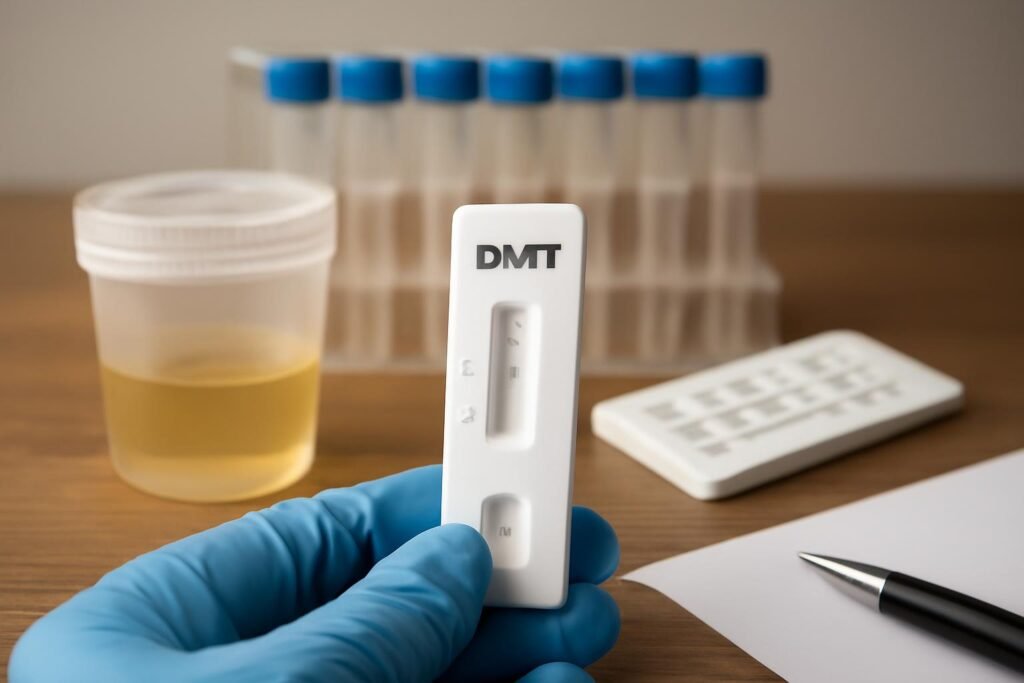
DMT drug testing raises a practical question for employees, healthcare patients, researchers, and anyone subject to toxicology screening: will a test identify DMT after use? The most accurate answer is that detection depends on the substance, the assay, the specimen collected, the timing, and the laboratory’s capabilities.
DMT is not typically part of the standard five-panel or expanded workplace screens used in the United States. Those panels commonly focus on substances such as cannabinoids, cocaine, amphetamines, opioids, and phencyclidine. However, the absence of DMT from a routine panel does not mean it can never be detected. A laboratory can order specialized testing when there is a specific clinical, forensic, employment, or research reason.
This guide explains the science and limitations of DMT testing without offering ways to defeat, manipulate, or evade a screening process. Test results are influenced by individual biology and laboratory methods, so no article can guarantee whether a particular sample will be reported as positive or negative.
Is DMT included in a standard drug test?
Usually, no. Most routine urine drug screens do not test for N,N-dimethyltryptamine, commonly called N,N-DMT or simply DMT. Standard panels are designed to identify a defined list of drug classes, and DMT is generally not included unless the ordering organization requests a specific assay.
That distinction matters because “drug test” is not one universal examination. A basic immunoassay panel, a laboratory confirmation test, and a broad forensic toxicology screen may have very different targets and detection capabilities. The name of the testing company alone does not reveal which substances are being analyzed.
When a test is required for employment, probation, medical care, athletics, or another formal purpose, the relevant documents should identify the panel or analytes. If the paperwork is unclear, the testing provider or responsible medical professional is the appropriate source for clarification.
How DMT testing differs from routine screening
Screening tests
Initial drug screens often use immunoassay technology. These tests are efficient and relatively inexpensive, but they are built to recognize particular drug classes or chemical structures. They are not automatically capable of identifying every psychoactive substance.
A routine panel that does not include DMT should not be interpreted as a comprehensive test for all psychedelics. Conversely, a broad panel does not necessarily mean that every psychedelic compound will be detected. The test must be designed and validated for the target substance or its metabolites.
Confirmatory laboratory testing
When a specific substance is suspected, laboratories may use techniques such as liquid chromatography–mass spectrometry or gas chromatography–mass spectrometry. These methods can be highly selective, but they still depend on the laboratory ordering the correct analyte, collecting the sample at a useful time, and using a validated method with an appropriate sensitivity threshold.
Specialized testing may focus on DMT itself, a short-lived metabolite, or a broader group of tryptamines. The precise target can vary between laboratories. This is one reason that generalized internet claims about DMT detection windows should be treated cautiously.
How long does DMT stay in urine?
There is no universally reliable urine detection window for DMT. The compound is rapidly metabolized, and available data are more limited than the evidence available for commonly tested substances. In addition, many routine urine panels do not look for DMT in the first place.
Several factors can affect whether a specialized urine test identifies DMT or a related metabolite:
- Time since exposure: Concentrations can change quickly after use, and a sample collected later may not reflect the same compounds present shortly after exposure.
- Test sensitivity: Different laboratories use different cutoffs, instruments, and validated methods.
- Metabolism: Liver enzyme activity, genetics, age, health status, and interactions with other substances can influence processing.
- Specimen characteristics: Urine concentration varies with normal hydration, kidney function, and collection timing.
- Compound identity: N,N-DMT, 5-MeO-DMT, and 4-AcO-DMT are chemically different substances and should not be treated as interchangeable.
For these reasons, a simple statement such as “DMT leaves the urine in a certain number of hours” is not dependable medical or forensic guidance. Anyone facing a formal test should follow the applicable rules and obtain advice from the testing authority or a qualified professional rather than relying on a predicted timeline.
Can DMT show up on a drug test?
It can show up on a test specifically designed to detect it, but it is generally unlikely to appear on an ordinary workplace panel that does not include DMT. The answer depends on what the laboratory was instructed to analyze.
A result also requires interpretation. A laboratory may report a target analyte, a metabolite, or an inconclusive finding depending on the specimen and method. In regulated settings, presumptive results are commonly followed by confirmation procedures. The meaning of a result should therefore be discussed with the medical review officer, clinician, or other authorized professional involved in the testing program.
It is also important not to confuse a test’s scope with a substance’s legal status. Whether DMT is included in a panel does not determine whether possession, distribution, or use is lawful in a particular jurisdiction. Readers seeking general background can review the educational material available through the site’s DMT information hub, while recognizing that legal rules can change and may differ by state.
What about 5-MeO-DMT and 4-AcO-DMT?
Searches for “DMT drug testing” often combine several different compounds. That can create confusion because N,N-DMT, 5-MeO-DMT, and 4-AcO-DMT do not have identical chemistry, metabolism, or laboratory detection methods.
N,N-DMT is the compound most people mean when they use the unqualified term DMT. 5-MeO-DMT is a distinct tryptamine with different pharmacological effects and risks. 4-AcO-DMT is another separate compound that may be discussed as a psilocybin-related research chemical, although its legal status and risks require careful evaluation.
A test designed for one compound should not automatically be assumed to detect another. Some broad analytical methods may identify multiple substances, but that depends on the laboratory’s target list and validation data. Product labels, informal names, and online descriptions are not substitutes for verified chemical identification.
This is particularly important with cartridges, powders, plant materials, changa, and other products marketed under broad names. Actual contents may vary, and unexpected ingredients can create both health and testing risks. The site’s general educational resources directory includes background topics on DMT effects, risks, legality, and related subjects; readers should use those materials for education rather than assuming that any product description guarantees composition.
Does a DMT drug test measure impairment?
Not necessarily. Toxicology tests generally identify the presence of a substance or metabolite above a laboratory threshold. They are not usually a direct measurement of current impairment, judgment, coordination, or fitness for work.
This distinction is significant because a person may have a detectable analyte after noticeable effects have ended, while another person may be impaired without the substance being included in the test. Detection and impairment are related questions, but they are not the same question.
Anyone experiencing confusion, severe anxiety, chest pain, dangerous agitation, loss of consciousness, breathing problems, seizures, or other concerning symptoms should seek emergency medical help. Combining psychedelics with alcohol, stimulants, opioids, antidepressants, or other psychoactive substances can increase uncertainty and risk.
Can home drug test kits detect DMT?
Most consumer home drug test kits are designed for common drug classes and do not detect DMT. A kit that advertises a broad “psychedelic” or “research chemical” screen should be examined carefully for its actual analytes, validation information, cutoff levels, and instructions.
Home tests can also produce false-positive or false-negative results. They are not equivalent to a regulated laboratory confirmation, and a negative home result cannot prove that a person will receive a negative result from a different test using a different method.
For medical, legal, employment, or treatment decisions, laboratory testing and professional interpretation are more appropriate than relying on an unverified kit. Do not attempt to dilute, substitute, adulterate, or otherwise manipulate a specimen. Such actions can create health risks, invalidate the test, and potentially result in additional consequences.
Why online detection-window claims are unreliable
Many websites publish exact claims about how long DMT remains in urine, blood, saliva, or hair. These figures often omit essential information: the dose, route, timing, assay, cutoff, metabolite measured, and characteristics of the person tested.
Hair testing presents additional complexity because incorporation into hair is affected by growth, pigmentation, cosmetic treatment, and laboratory procedures. Blood and saliva testing are also highly dependent on collection timing and the purpose of the examination. None of these matrices provides a simple universal answer.
The safest interpretation is that detection is test-specific and unpredictable from public estimates alone. If a legitimate testing requirement exists, the responsible approach is to disclose relevant prescribed medications and ask the appropriate professional about the process.
Questions to ask before a formal test
People who need clarity about a scheduled test can ask practical, non-evasive questions:
- What specimen will be collected: urine, blood, saliva, hair, or another sample?
- Which substances or analytes are included in the panel?
- Is the test a screening assay, a confirmatory test, or both?
- Who can explain a result if the initial finding is unexpected?
- How should legitimate prescriptions, supplements, or medical conditions be documented?
The answers may differ between an employer, healthcare provider, court, treatment program, and research study. Keeping communication direct and accurate is more reliable than attempting to predict a result from a generic online chart.
Frequently asked questions
Will DMT show up on a five-panel test?
Usually not. A five-panel test generally targets a defined group of commonly screened substances and does not ordinarily include DMT. Always verify the specific panel rather than assuming that every test uses the same targets.
Can one test detect all psychedelics?
No. Psychedelics vary substantially in chemistry and metabolism. A laboratory needs an appropriate target list and validated method. A test for N,N-DMT should not automatically be assumed to detect 5-MeO-DMT, 4-AcO-DMT, LSD, psilocybin, or other compounds.
Is there a guaranteed way to pass a DMT test?
No. Claims involving detox products, excessive water, supplements, or specimen manipulation are unreliable and may be dangerous. Testing outcomes depend on the assay, sample, timing, and individual biology.
Where can I learn more about responsible psychedelic education?
Begin with neutral information about pharmacology, risks, legality, and informed consent. The site’s product and information directory can help readers navigate available site content, but product listings should never be treated as medical advice, legal advice, or proof of laboratory composition.
The practical takeaway
DMT is usually absent from routine workplace drug panels, yet specialized testing can be designed to identify DMT or related compounds. Detection windows are difficult to predict because DMT is rapidly metabolized and laboratory methods vary. N,N-DMT, 5-MeO-DMT, and 4-AcO-DMT should not be treated as the same substance for testing or safety purposes.
If a test has legal, medical, employment, or treatment implications, rely on the official testing information and qualified professional guidance. Avoid making decisions based on exact online timelines, marketing claims, or home-test assumptions. Accurate information, honest communication, and attention to health and legal responsibilities are the most dependable safeguards.
