
Psychedelics Education
DMT Drug Testing: How Long DMT Stays Detectable and What U.S. Consumers Should Know
Nov
Why DMT Drug Testing Is More Complicated Than Most People Expect
Search interest in how long does DMT stay in your urine has grown alongside broader curiosity about psychedelics in the United States. It is a reasonable question. DMT (N,N-dimethyltryptamine) is famous for producing intense, short-lived experiences, and many people assume that a substance that lasts only minutes must clear the body just as quickly. That assumption is partly true and partly misleading.
The real answer depends on the test, the dose, the frequency of use, individual metabolism, and — critically — whether the laboratory is even looking for DMT in the first place. Most standard workplace drug panels do not screen for DMT. That single fact changes the practical risk picture far more than the difference between a 12-hour and a 24-hour detection window.
This guide breaks down what is known about DMT detection across urine, blood, saliva, and hair testing, why routine panels often miss it, and how consumers should interpret at-home test kits. It is educational information, not medical or legal advice, and it does not replace guidance from a qualified clinician or attorney.
How DMT Is Metabolized in the Body
DMT is rapidly broken down after ingestion or inhalation. The enzyme monoamine oxidase (MAO) metabolizes DMT into several breakdown products, including indole-3-acetic acid (IAA) and other minor metabolites. This enzymatic activity is one reason DMT is not orally active unless it is combined with an MAO inhibitor — the principle behind ayahuasca and changa preparations.
Because clearance is fast, parent DMT is usually present in blood and urine only briefly. Detection therefore depends heavily on timing. A sample collected many hours after use may contain little or no identifiable parent compound, even though metabolites may linger slightly longer.
This is also why DMT is sometimes described as one of the least detectable classic psychedelics in routine screening. The window is narrow, and the compound is not a standard target on most panels.
How Long Does DMT Stay in Your Urine?
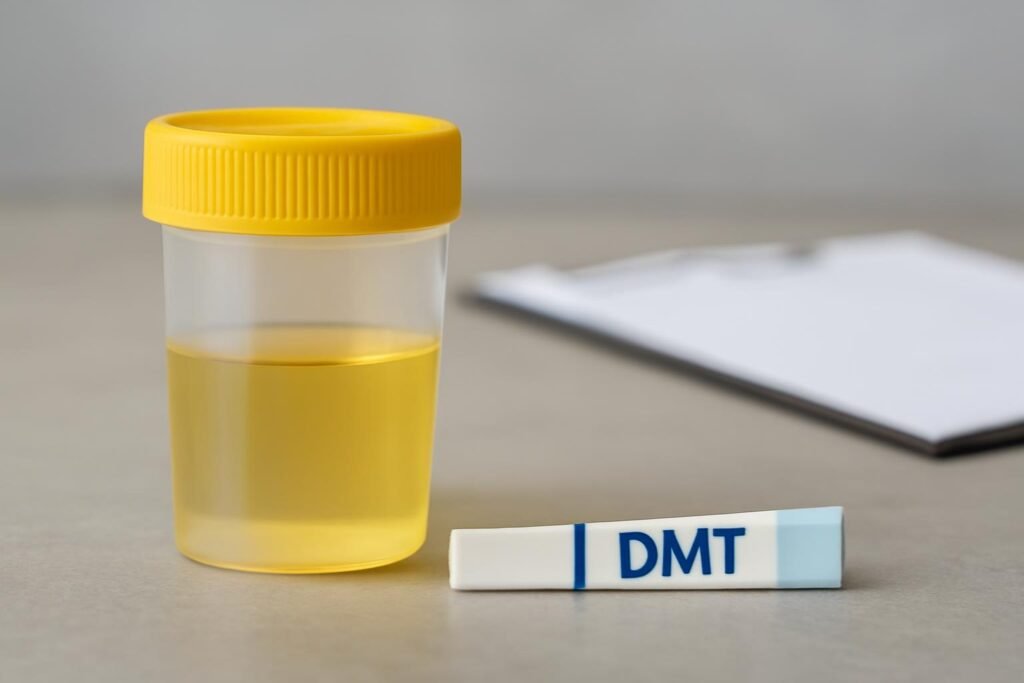
Urine testing is the most common form of drug screening in the United States, so this is usually the question people care about most. Published clinical and forensic literature suggests that parent DMT in urine is typically detectable for a relatively short period — often described in the range of hours rather than weeks.
In practical terms, many references place the urine detection window for DMT at roughly 6 to 24 hours after use, with some variability. Factors that can extend or shorten that window include:
- Dose and route of administration: Larger doses or repeated dosing may produce more detectable metabolite.
- Frequency of use: Chronic or clustered use may increase the chance of detection compared with a single session.
- Individual metabolism: Liver enzyme activity, body composition, hydration, and genetics all vary between people.
- Sample concentration: Dilute urine can push a result below the cutoff, while concentrated samples may remain positive longer.
- Laboratory cutoff levels: A lab using a very low cutoff may detect trace amounts that a standard panel would miss.
It is important to treat these figures as general ranges, not guarantees. No responsible source can tell an individual exactly when their sample will be clean.
Does DMT Show Up on a Standard Drug Test?
Usually, no. The most common workplace panels — the five-panel, seven-panel, and ten-panel screens — typically target substances such as amphetamines, cocaine, opiates, PCP, marijuana, benzodiazepines, barbiturates, methadone, and methamphetamine. DMT is generally not included.
That does not mean DMT can never be detected. Specialized forensic testing, expanded psychedelic panels, and confirmatory mass spectrometry can identify DMT and its metabolites when a lab is specifically asked to look. If you are facing a legal, employment, or clinical situation where DMT testing is a concern, the specific panel matters more than general internet ranges.
For a broader look at how test kits are used and where they fall short, see our guide to the DMT drug test kit and what it can and cannot tell you.
Detection Windows by Test Type
Different biological matrices carry different detection windows. The table below summarizes commonly cited general ranges for DMT, with the caveat that individual results vary.
Blood Testing
Blood is the most direct way to measure recent exposure. Parent DMT in blood is typically detectable only for a short period — often measured in hours — after use. Blood testing is uncommon in routine employment screening but may appear in clinical research, emergency medicine, or forensic investigations.
Saliva Testing
Oral fluid testing is increasingly used in workplace and roadside settings. For most substances, saliva detection reflects recent use over roughly a day or so. DMT-specific data are limited, but the short half-life of the compound suggests a narrow window similar to or shorter than urine.
Hair Testing
Hair testing has the longest detection window of the common matrices, often measured in months. However, DMT is not a standard hair-test target, and published data on hair incorporation are sparse. Hair tests are also expensive and less common in ordinary employment screening. Anyone concerned about hair testing should consult a forensic toxicologist rather than rely on general ranges.
What About At-Home DMT Test Kits?
At-home test kits fall into two broad categories, and confusing them is a common mistake.
Reagent and purity tests are designed to check whether a substance contains what it is supposed to contain. These are harm-reduction tools. They can help identify adulterants or confirm the presence of a expected compound, but they do not tell you whether a person will test positive on a drug screen.
Immunoassay urine strips are screening tools. Most commercially available strips do not include DMT-specific antibodies, so a standard multi-panel strip will not detect DMT at all. A negative result on a generic panel tells you nothing about DMT exposure.
If you need to understand your actual testing exposure, the right move is to ask the testing laboratory which panel is being used and whether DMT or its metabolites are included. That is a far more reliable answer than any at-home kit.
Why the Detection Window Is Only Part of the Risk Picture
People often focus on detection windows because they are trying to manage a specific concern. But in the United States, DMT remains a Schedule I controlled substance under federal law. Possession, purchase, and distribution carry legal risk that is independent of whether a drug test would catch it.
State-level frameworks are changing. Colorado’s natural medicine program, for example, has created regulated access pathways for certain psychedelic services, and other states are debating similar models. These programs are narrow, licensed, and do not amount to general retail availability. Understanding the difference between a regulated therapeutic pathway and an unregulated online marketplace is essential. Our overview of DMT legal status explains how federal scheduling and state programs interact.
There is also a product-quality dimension. Unregulated DMT products — including vape cartridges and powders — vary widely in purity and may contain contaminants. Detection is not the same as safety. A product that would never show up on a standard panel can still cause serious harm if it is adulterated or dosed incorrectly.
Factors That Influence How Long DMT Remains Detectable
No two people metabolize DMT identically. The following variables are the most commonly cited influences on detection time:
- Route of administration: Inhaled DMT reaches the bloodstream quickly and clears quickly. Oral preparations combined with MAO inhibitors may produce different pharmacokinetics.
- Dose: Higher doses generally mean more compound and metabolite to clear.
- Frequency: Repeated use over consecutive days may extend the window compared with isolated use.
- Hydration and kidney function: These affect urine concentration and therefore whether a sample crosses a cutoff.
- Liver enzyme activity: MAO and CYP enzyme variation can change how quickly DMT is broken down.
- Body composition: Lipophilic compounds can distribute into fatty tissue, though DMT’s rapid clearance limits this effect compared with substances like THC.
Because these factors interact, any single number should be treated as a rough estimate rather than a personal prediction.
DMT, 5-MeO-DMT, and 4-AcO-DMT: Testing Differences
Not all tryptamines behave the same way, and testing panels may treat them differently.
5-MeO-DMT is a distinct compound with a different pharmacological profile. It is more potent by weight and carries different safety considerations, particularly around respiratory and cardiovascular effects. Detection data specific to 5-MeO-DMT are limited, and it is not a standard panel target.
4-AcO-DMT is a synthetic tryptamine that acts as a prodrug to psilocin. Because it converts to psilocin, some testing scenarios may look for psilocin or psilocybin metabolites rather than 4-AcO-DMT itself. This is a nuanced area where laboratory confirmation matters.
For a side-by-side comparison of effects, risks, and legal context, see our article on 5-MeO-DMT vs. NN-DMT.
Practical Takeaways for U.S. Consumers
If your concern is a routine workplace drug screen, the most important fact is that DMT is usually not on the panel. If your concern is a specialized or legal test, assume that a laboratory can detect more than a generic strip and seek specific information about the panel being used.
If your concern is personal safety, detection windows are the wrong lens. The more meaningful questions are about product purity, dosing accuracy, set and setting, mental health screening, and legal exposure. DMT is not considered physically addictive in the way opioids or stimulants are, but psychological intensity and risk of destabilizing experiences are real. Our discussion of DMT risks covers the safety considerations that matter more than any detection timeline.
Finally, be skeptical of anyone who offers a precise, guaranteed detection window. Human biology does not work that way, and reputable toxicologists will say so.
Frequently Asked Questions
How long does DMT stay in your urine?
General references place the urine detection window for parent DMT at roughly 6 to 24 hours after use, though this varies with dose, frequency, metabolism, and laboratory cutoff. DMT is not included on most standard drug panels.
Can DMT show up on a drug test?
It can, but usually only if the laboratory is specifically testing for it. Standard five-, seven-, and ten-panel screens typically do not include DMT. Specialized forensic panels and confirmatory mass spectrometry can detect it.
Does a standard at-home drug test detect DMT?
Generally no. Most at-home immunoassay strips do not include DMT-specific antibodies. A negative result on a generic panel does not confirm the absence of DMT exposure.
Is DMT addictive?
DMT is not considered physically addictive in the way opioids or stimulants are, and it does not produce classic withdrawal syndromes. However, some individuals may use it compulsively or in ways that cause psychological distress. Anyone with a personal or family history of psychosis should be especially cautious.
How long does DMT stay in blood?
Parent DMT in blood is typically detectable only for a short period, often measured in hours after use. Blood testing is uncommon in routine screening.
Can you overdose on DMT?
DMT has a wide margin between typical doses and dangerous doses, but overdose is still possible, particularly with potent analogs like 5-MeO-DMT or when combined with other substances. Cardiovascular and respiratory effects are the primary concerns. Our article on DMT FAQs addresses common safety questions in more detail.
Does DMT show up on a hair test?
Hair testing has the longest general detection window, often months, but DMT is not a standard hair-test target and published data are limited. Consult a forensic toxicologist for case-specific guidance.
Final Thoughts
The question of how long DMT stays in your urine has a short answer and a longer one. The short answer is that DMT clears quickly, and most routine drug panels do not look for it. The longer answer is that detection depends on the test, the dose, the person, and the laboratory — and that legal and safety risks matter far more than any detection window.
Consumers in the United States should approach DMT information with the same rigor they would apply to any other health or legal question: verify the source, understand the panel, and do not confuse the absence of detection with the absence of risk.
